
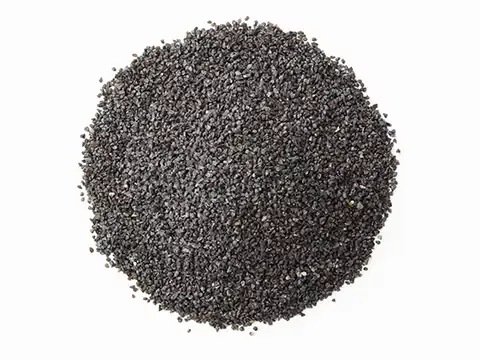
A turbine component manufacturer replaced a garnet and steel-grit media blend with BLASTITE® brown aluminum oxide. This documented case shows how closely graded aluminum oxide blasting media for metal preparation helped one manufacturer reduce blasting passes, minimize processing time, simplify media management, and lower abrasive consumption, ultimately reducing the cost of refinishing carbon steel turbine parts.
|
Application: Metal surface finishing with aluminum oxide
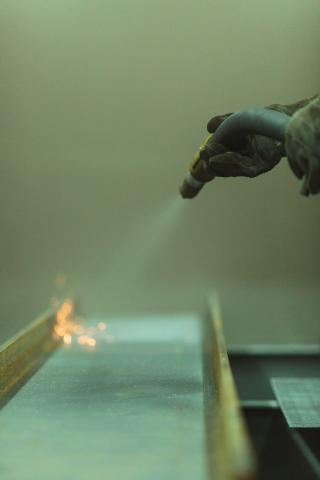
Abrasive blasting was used to refinish carbon steel turbine components and produce the required surface condition. The manufacturer needed a blasting medium that could achieve the desired finish with fewer passes while supporting more consistent results.
Challenge: High media consumption and excessive processing time
The manufacturer had been using a blend of garnet and steel grit. In this operation, the media blend required more passes than expected to produce the target finish, resulting in high abrasive consumption and extended blasting time. The customer wanted to reduce material usage and cost per finished component without compromising the required surface condition.
|
Evaluation and abrasive media recommendation
Washington Mills visited the customer's operations to review its blasting process, media consumption, and required finish. The evaluation indicated that the existing combination of garnet and steel grit was not aggressive enough to produce the required result within an efficient number of passes.
Washington Mills recommended testing 20 grit BLASTITE®, a closely graded brown aluminum oxide blasting medium. The objective was to replace the two-material blend with a single pressure blasting medium that could provide the cutting action, durability, and size consistency needed for the customer’s process.
Documented results
| Measure | Before | After |
|---|---|---|
| Blast media | Garnet and steel-grit blend | 20 grit BLASTITE® |
| Media system | Two-material abrasive blend | Single abrasive medium |
| Blasting time | Baseline process | Reduced by 50% |
| Abrasive consumption | 25,000 lb. per month | 20,000 lb. every 7–8 weeks |
| Operational outcome | Excessive passes and high consumption | Lower abrasive consumption and faster part processing, reducing total cost per finished part |
The change consolidated the operation from a blended system to one closely graded abrasive medium. Documented results show the customer cutting blasting time in half and reducing both the frequency and volume of abrasive replacement. These changes allowed the manufacturer to process components more efficiently and reduce abrasive-related operating costs.
Why aluminum oxide improved this operation
The improvement seen by the customer was not based solely on replacing one abrasive material with another. Washington Mills evaluated the full operating problem—including the required finish, number of passes, media consumption, and material consistency—and recommended a closely graded abrasive suited to the customer’s pressure-blasting process.
For this manufacturer, using one specified aluminum oxide product not only improved consistency and results, it also simplified media management compared with maintaining a two-material media blend.
Other blasting materials and technical resources
Abrasive selection depends on the substrate, required surface condition, blasting system, grit size, media-recovery method, and operating economics. Washington Mills offers multiple fused mineral products and technical resources for evaluating blasting media options and industrial surface preparation applications.
Explore BLASTITE®
Closely sized brown aluminum oxide for pressure blasting, profiling, cleaning, scale removal, and related surface-preparation uses. Conforms to exacting specifications, including A-A-59316, D50TF5-S8 Class D, PMC 3052 rev. BD, and PMC 3043-1 rev. AR.
BLASTITE® Screen Analysis
Review ANSI B74.12 Table 3 size-distribution requirements for BLASTITE® blasting grain in grit sizes 16 through 240.
Explore blasting media
Review and compare Washington Mills’ guidance on abrasive selection, surface preparation, grit blasting, and wet or dry blasting processes.
Aluminum Oxide for Pressure Blasting: BLASTITE® Case Study
See how Washington Mills evaluated another pressure blasting application using a different product from the high-quality brown aluminum oxide family.
Optimize for your blasting operation
Washington Mills can help evaluate abrasive type, grit size, desired finish, media consumption, and operating conditions for metal surface preparation and refinishing processes.
The outcome of this case study was specific to this equipment, substrate, target finish, operating conditions, and media selection. Abrasive performance should be evaluated against the requirements of each blasting process.